
Why Manual Payroll Fails Growing Businesses in India?

At first, spreadsheets may seem manageable. However, as headcount increases, regulations tighten, and salary structures become complex, manual payroll quickly turns into a business risk.
For growing businesses in India, payroll is no longer just about salary calculation. Instead, it involves compliance, accuracy, timeliness, reporting, and employee trust. This is exactly why manual payroll starts failing - and why automation becomes unavoidable.
In this blog, you’ll learn why manual payroll fails growing businesses in India, what risks it creates, and how automation solves these challenges end-to-end.
What Is Manual Payroll?
Manual payroll refers to managing salary calculations, deductions, compliance, and payslips using spreadsheets, emails, and disconnected tools.
Typically, HR or finance teams:
- Calculate salaries in Excel
- Manually apply PF, ESI, PT, and TDS
- Upload challans on government portals
- Share payslips via email
Initially, this works. However, as teams grow, the system starts breaking down.
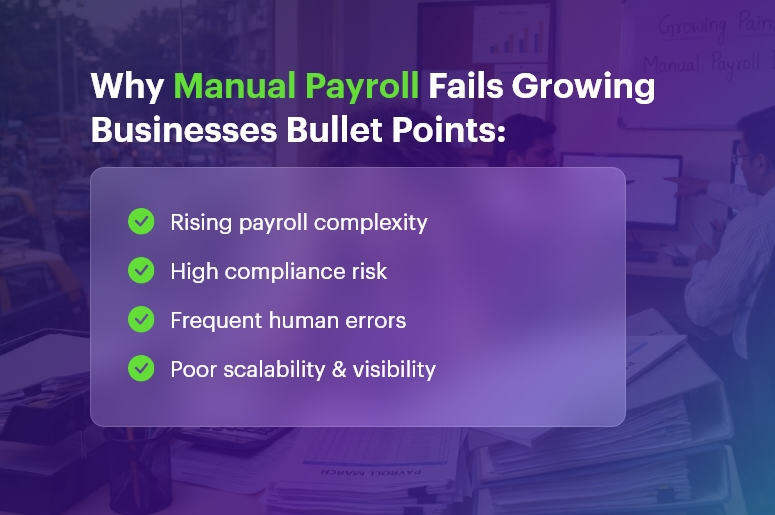
Why Manual Payroll Fails Growing Businesses in India
1. Payroll Complexity Increases Rapidly with Growth
As employee count rises, payroll rules multiply. New salary components, multiple pay structures, variable pay, bonuses, and deductions add complexity.
Because manual systems lack built-in logic, errors increase with every change. As a result, payroll becomes fragile and unreliable.
2. Indian Statutory Compliance Is Too Complex to Manage Manually
India’s payroll compliance landscape is demanding. Businesses must manage:
- Provident Fund (PF)
- Employee State Insurance (ESI)
- Professional Tax (PT)
- Income Tax (TDS)
- State-wise rules and slabs
- Monthly, quarterly, and annual filings
Since regulations change frequently, manual payroll struggles to keep up. Consequently, compliance risks grow silently.
3. Human Errors Become Inevitable
Manual payroll depends heavily on human accuracy. Unfortunately, even a small mistake can lead to:
- Incorrect salary payouts
- Wrong tax deductions
- Compliance penalties
- Employee dissatisfaction
Because spreadsheets lack validation and automation, errors often go unnoticed until employees raise concerns.
4. Payroll Processing Consumes Too Much Time
Manual payroll requires repetitive tasks every month. Teams must:
- Verify attendance and leave data
- Update salary changes
- Recheck calculations
- Prepare compliance files
As a result, HR and finance teams spend days on payroll instead of focusing on strategic work.
5. Scaling Across Locations Becomes Difficult
Growing businesses often expand across cities or states. However, each state in India has different:
- Professional tax slabs
- Labour welfare fund rules
- Compliance requirements
Manual payroll cannot scale smoothly across locations. Therefore, complexity increases faster than control.
6. Lack of Real-Time Visibility and Reporting
Manual payroll offers limited visibility. Since data is scattered across files, managers struggle to:
- Track payroll costs
- Analyze salary trends
- Prepare audit-ready reports
As a result, decision-making becomes slow and reactive.
7. Payroll Errors Damage Employee Trust
Salary accuracy directly impacts employee morale. When payroll errors happen repeatedly:
- Trust in HR declines
- Support tickets increase
- Employee engagement suffers
Eventually, payroll issues affect retention and employer brand.
The Hidden Cost of Manual Payroll
Although manual payroll appears cost-effective, it carries hidden costs such as:
- Compliance penalties
- Rework and corrections
- Time lost on repetitive tasks
- Employee dissatisfaction
- Audit risks
Over time, these costs far exceed the investment in automation.
Why Payroll Automation Is the Only Sustainable Solution
Payroll automation replaces spreadsheets with a rule-driven, compliance-ready system. As a result:
- Calculations become accurate
- Compliance stays updated automatically
- Processing time reduces drastically
- Reporting becomes instant
Most importantly, payroll becomes predictable and stress-free.
How IndPayroll Solves These Challenges
IndPayroll is designed specifically for Indian businesses. It helps growing companies:
- Automate salary calculations and deductions
- Stay compliant with PF, ESI, PT, and TDS
- Handle state-wise payroll rules with ease
- Generate payslips and statutory reports instantly
- Scale payroll without increasing workload
As a result, businesses move from payroll firefighting to payroll confidence.
When Should a Business Move Away from Manual Payroll?
You should consider automation if:
- Employee count exceeds 20–30
- Payroll processing takes more than a day
- Compliance updates feel stressful
- Errors occur frequently
- HR spends too much time fixing payroll issues
If any of these sound familiar, manual payroll has already started failing.
Best Practices for Transitioning from Manual to Automated Payroll
To ensure a smooth transition:
- Centralize employee and salary data
- Standardize salary components
- Choose India-compliant payroll software
- Automate statutory calculations and filings
- Train HR teams on payroll workflows
When done right, the transition feels effortless.
Final Takeaway
Manual payroll may work for very small teams. However, it fails to grow businesses in India due to complexity, compliance pressure, and scalability limits.
Payroll automation is no longer a luxury. Instead, it is a necessity for accuracy, compliance, and growth.
If your business is scaling, it’s time to leave spreadsheets behind-and move to a smarter, automated payroll system.
Frequently Asked Questions (FAQs)
1. Why does manual payroll become risky as a company grows?
As companies grow, payroll complexity increases. Therefore, manual payroll becomes prone to calculation errors, compliance gaps, and delays that can directly impact employees and finances.
2. Is manual payroll legally compliant in India?
Manual payroll is not illegal. However, because Indian payroll laws change frequently, staying compliant manually becomes difficult. As a result, businesses face a higher risk of penalties and notices.
3. What are the most common errors in manual payroll?
Common errors include incorrect salary calculations, wrong PF or TDS deductions, missed filings, and outdated tax slabs. Consequently, these errors lead to rework and employee dissatisfaction.
4. How does manual payroll affect HR productivity?
Manual payroll consumes significant HR time every month. Therefore, HR teams spend less time on talent management and more time fixing payroll issues.
5. Can manual payroll handle PF, ESI, and TDS efficiently?
While it is possible, it is not efficient. Since each statutory component has different rules and deadlines, manual payroll struggles to manage them accurately and consistently.
6. Why do growing businesses struggle with multi-state payroll manually?
Each Indian state follows different professional tax and labour welfare rules. As a result, managing multi-state payroll manually increases complexity and error risk.
7. How does manual payroll impact employee trust?
Payroll errors directly affect take-home salary. Therefore, repeated mistakes reduce employee trust and increase complaints, which harms overall engagement.
8. Is manual payroll cost-effective for small teams?
Initially, it may seem cost-effective. However, as the team grows, hidden costs like errors, penalties, and time loss make manual payroll more expensive in the long run.
9. When should a business move away from manual payroll?
Businesses should switch when payroll processing becomes time-consuming, errors occur frequently, or compliance feels stressful. At that stage, manual payroll is no longer sustainable.
10. How does IndPayroll help businesses move away from manual payroll?
IndPayroll automates salary calculations, statutory compliance, and reporting. As a result, businesses eliminate manual errors, stay compliant, and scale payroll operations with confidence.
Run your next payroll in 15 minutes
Trusted by 1,000+ Indian businesses to run compliant payroll, automatically.