
Manual Payroll vs Payroll Software: What Works Best for Indian SMEs?
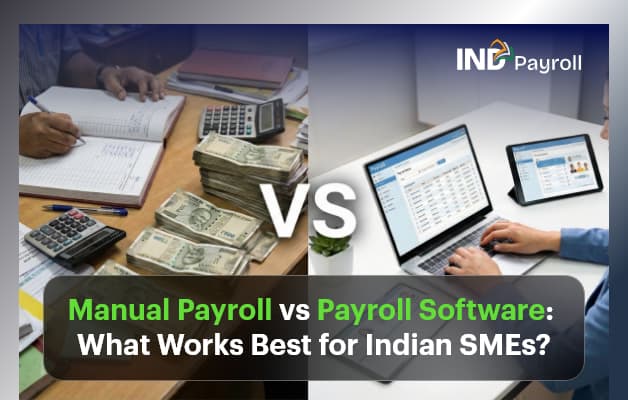
Managing payroll remains a critical but complex task for Indian small and medium enterprises (SMEs). Today, we compare Manual Payroll vs Payroll Software to determine what works best for Indian SMEs. We also explain the key differences, benefits, challenges, costs, and best practices.
In India, SMEs must handle salary calculations, statutory compliance, tax deductions, and employee records efficiently. Traditionally, many businesses relied on manual payroll processes. However, with rising workforce sizes and regulatory complexity, payroll software has emerged as a powerful alternative.
What is Manual Payroll?
Manual payroll refers to processing employee salaries, deductions, and statutory contributions by hand or using spreadsheets.
Many SMEs still choose manual payroll because it seems cheaper or more familiar. Nevertheless, it carries risks and becomes less sustainable as the business grows.
How Manual Payroll Works?
- HR or accounts personnel calculate gross salary
- Deduct taxes, PF, ESI, and professional tax manually
- Prepare pay slips in spreadsheets
- Record payments in books
- Remit statutory contributions manually
What is Payroll Software?
Payroll software automates payroll processing through specialised digital tools. These systems calculate salaries, generate slips, manage compliance, and store reports automatically.
Cloud-based software further enables online access and multi-user collaboration.
Payroll software typically includes:
- Automated salary calculations
- Tax computation and filing support
- Digital payslips and records
- Compliance updates for Indian laws
- Integration with attendance systems
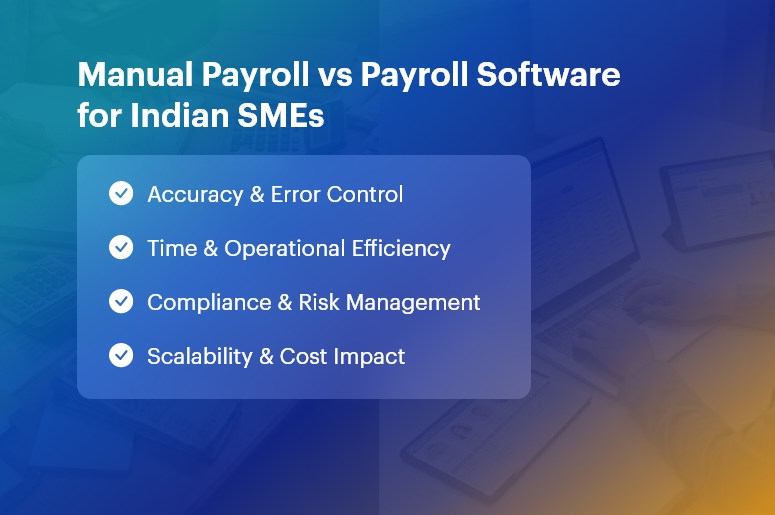
Key Differences: Manual Payroll vs Payroll Software
1. Accuracy
Manual payroll often causes human errors in calculations and compliance. In contrast, payroll software uses automated formulas that reduce errors significantly.
2. Time Efficiency
Manual payroll demands extensive time for calculations and reconciliation. Conversely, payroll software completes processing within minutes, even for large teams.
3. Compliance Management
India’s statutory requirements (PF, ESI, TDS, and professional tax) change frequently. Manual payroll struggles to keep up, while software updates automatically with regulatory changes.
4. Cost Considerations
Manual payroll appears inexpensive at first but generates hidden costs in:
- Wages spent on processing
- Error corrections
- Penalties due to non-compliance
Payroll software requires a subscription fee but reduces long-term costs by improving accuracy and saving time.
5. Scalability
Startups and SMEs grow quickly; manual payroll cannot scale easily. Payroll software handles growth efficiently, whether you add 5 or 500 employees.
Benefits of Payroll Software for Indian SMEs
1. Improved Accuracy
Payroll software eliminates manual calculations and minimises errors. It also maintains precise records.
2. Faster Payroll Cycles
Automated processes save hours every month, leading to faster salary disbursements.
3. Better Compliance
Software tracks regulatory updates and automatically applies new rates for PF, ESI, and taxes.
4. Secure Data Storage
Cloud payroll platforms secure sensitive payroll data and reduce risks from lost spreadsheets.
5. Real-Time Reporting
Finance teams get instant access to payroll reports, aiding planning and audits.
Challenges of Manual Payroll for SMEs
1. Human Error
Manual entry increases the likelihood of mistakes in salary calculations and compliance.
2. Time-Consuming
Processing payroll manually drains valuable HR and finance resources.
3. Compliance Risks
Manual systems often fail to capture regulatory changes, causing legal penalties.
4. Lack of Integration
Manual payroll rarely integrates with attendance, leave, or accounting systems.
When Manual Payroll Might Still Work
While payroll software is superior for most, very small businesses with fewer than 10 employees and simple salary structures may find manual processing workable initially.
However, as businesses grow, transitioning to payroll software becomes essential.
Key Features to Look for in Payroll Software
When selecting payroll software, Indian SMEs should evaluate:
- Compliance with Indian laws
- Automatic tax and statutory calculations
- Integration with attendance and HR systems
- Cloud access and mobile support
- Secure data storage
- Customizable payslip formats
- Customer support and training
Cost Comparison: Manual vs Payroll Software
In most cases, payroll software provides a higher return on investment than manual payroll over time.
Transitioning from Manual to Payroll Software
To transition smoothly:
- Evaluate current payroll needs
- Select software that fits your budget
- Migrate historical data carefully
- Train HR and finance teams
- Review and monitor during the first few cycles
Conclusion
In the debate of Manual Payroll vs Payroll Software, payroll software consistently proves more efficient, accurate, and cost-effective for Indian SMEs. While manual payroll may work for very small teams, it cannot match the scalability, compliance support, and automation that payroll software delivers.
Indian SMEs that adopt payroll automation reduce errors, save time, and stay compliant in a complex regulatory environment. Therefore, payroll software is the best long-term solution for growing businesses.
Frequently Asked Questions (FAQs)
1. What is the main difference between manual payroll and payroll software?
The primary difference between manual payroll vs payroll software lies in automation and accuracy. Manual payroll depends on spreadsheets and human calculations, whereas payroll software automates salary processing, tax deductions, compliance, and reporting, thereby reducing errors and saving time.
2. Is manual payroll legal for Indian SMEs?
Yes, manual payroll is legal in India. However, SMEs must still comply with statutory regulations such as PF, ESI, TDS, and professional tax. Because regulations change frequently, manual payroll increases the risk of non-compliance and penalties.
3. Why is payroll software better for compliance in India?
Payroll software automatically updates statutory rules related to Indian payroll laws. As a result, it ensures accurate PF, ESI, and tax calculations and helps SMEs remain compliant without constantly tracking regulatory changes manually.
4. How does payroll software reduce payroll errors?
Payroll software minimises errors by automating salary calculations, deductions, and statutory contributions. Since the system follows predefined rules, it eliminates common human mistakes that occur in manual payroll processing.
5. Is payroll software expensive for small businesses?
Payroll software is generally affordable for Indian SMEs. Although it involves a subscription cost, it reduces long-term expenses by saving time, preventing compliance penalties, and improving payroll efficiency compared to manual payroll.
6. When should an SME switch from manual payroll to payroll software?
An SME should switch to payroll software when employee strength increases, compliance becomes complex, or payroll errors start affecting operations. In most cases, businesses benefit from payroll automation as soon as they begin scaling.
7. Can payroll software handle Indian tax structures and deductions?
Yes, modern payroll software supports Indian salary structures, tax slabs, exemptions, PF, ESI, professional tax, and TDS. Therefore, it simplifies payroll processing in India and ensures statutory accuracy.
8. Does payroll software integrate with attendance and HR systems?
Most payroll software solutions integrate seamlessly with attendance, leave management, and HR systems. Consequently, salary calculations become more accurate, and HR teams gain better operational visibility.
9. Is payroll data secure in cloud-based payroll software?
Reputable payroll software providers use encryption, access controls, and regular backups. As a result, cloud payroll systems often provide higher data security than spreadsheets used in manual payroll.
10. What works best for growing Indian SMEs: manual payroll or payroll software?
For growing Indian SMEs, payroll software works best. It supports scalability, ensures compliance, reduces errors, and saves time. In contrast, manual payroll becomes inefficient and risky as business complexity increases.
Run your next payroll in 15 minutes
Trusted by 1,000+ Indian businesses to run compliant payroll, automatically.