
Employee Self‑Service in Payroll: A Win for Transparency and Productivity
Every time an employee emails HR for a pay stub or a correction, you lose productivity, clarity, and a bit of trust. That’s why employee self-service in payroll isn’t just a convenience - it’s a genuinely transformative approach to transparency and efficiency. Self-service portals reliably cut HR workload by up to 30%, speed up responses, and measurably boost employee confidence in how they’re paid.
Here’s why employee self-service in payroll matters in 2026, the benefits it delivers, and how to implement it well.
Why Employee Self‑Service in Payroll Matters
When employees rely on HR for every payslip or deduction question, HR teams get overloaded and delays frustrate everyone involved. A payroll self-service portal solves that - and unlocks broader benefits across the organisation.
1. Enhances payroll transparency
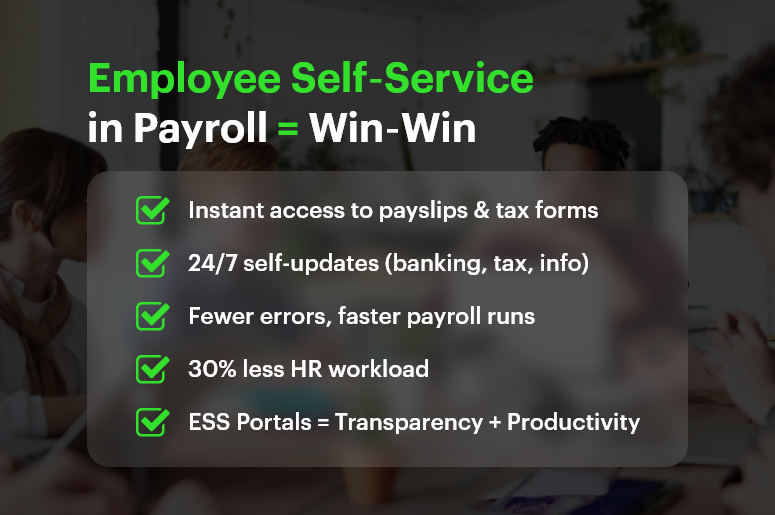
- A self-service portal gives employees instant access to payslips, deductions, tax declarations, and earnings history.
- With on-demand visibility, trust rises because payroll stops feeling like a black box.
2. Boosts productivity and reduces HR workload
- Letting employees self-serve routine requests cuts HR queries by roughly a third.
- That frees HR for strategic work - onboarding, retention, culture - instead of repetitive admin.
3. Improves payroll accuracy
- When employees enter their own details - bank information, tax regime election, personal data - errors drop significantly compared to HR re-keying everything manually.
- Built-in validation catches discrepancies before payroll is final
Who Benefits Most? Industries That Gain from ESS in Payroll
Employee self-service in payroll delivers ROI across sectors:
- Retail and hospitality: High-volume, hourly staff with frequent deduction changes rely on immediate pay transparency to avoid disputes.
- Manufacturing and logistics: Rotating shift workers need real-time payroll visibility to confirm hours across multiple sites.
- Professional services and startups: Tight payroll schedules, project-based compensation, and fast-changing headcount all benefit from employees being able to self-serve rather than wait on HR.
Across all three, self-service consistently leads to fewer errors, more confident employees, and a more focused HR function.
Best Practices & Actionable Tips for ESS in Payroll
Effective self-service deployment follows a few consistent patterns.
1. Implement a unified ESS portal
Use one platform that connects payroll, HR, and attendance data, so a change in one module - leave, benefits, classification - reflects everywhere immediately.
2. Offer mobile and 24/7 access
Employees should be able to view pay details, request updates, and download payslips anytime, from a phone. Anything less falls short of what a modern workforce expects.
3. Enable self-updates with automatic validation
Let employees update bank details, tax regime choice, or emergency contacts themselves, with validation rules that catch incorrect entries before they reach payroll processing.
4. Cut HR tickets with transparent information
When employees can access payslips and tax documents on their own, routine HR inquiries drop sharply - fewer repetitive email threads for the same handful of questions every month.
5. Integrate ESS with leave and benefits
Link self-service to leave balances, PTO requests, and benefit elections so every update flows into payroll automatically, without a manual adjustment step.
6. Provide pre-payroll error alerts
Flag missing data, incomplete profiles, or mismatched information before the final payroll run - catching issues here is far cheaper than correcting a payslip after the fact.
7. Empower employees to improve engagement
Giving staff visibility into and some control over their own payroll data drives accountability and morale - employees who understand their pay trust it more.
8. Use secure, role-based access
Multi-factor authentication and role-based visibility keep employees seeing only their own data. This isn’t just good practice anymore - under India’s DPDP Act, 2023, securing personal payroll data is a legal obligation, and access controls are the first line of defence.
Customer Success /Case Study
BrightWorks Co., a mid-sized manufacturing company with 300 employees, rolled out employee self-service in payroll through IndPayroll, giving staff mobile access to payslips, banking and tax updates, PTO requests, and unclaimed hours submission. Within two months, HR queries dropped 35%, the payroll error rate fell 60% thanks to pre-payroll validation, and employee satisfaction rose 20% - driven largely by the transparency and autonomy the portal gave staff.
Key Takeaways & Closing
Employee self-service in payroll is a genuine win-win in 2026:
- Transparency: Employees access their payroll data instantly, reducing confusion and building trust.
- Productivity: HR spends less time on routine tickets and more on work that actually requires judgment.
- Accuracy: Self-entry with validation catches errors before payroll is processed, not after.
With INDPayroll, employee self-service becomes more than a convenience feature - it becomes a backbone of data integrity, engagement, and operational efficiency, helping businesses scale without adding HR overhead.
Frequently asked questions
Run your next payroll in 15 minutes
Trusted by 1,000+ Indian businesses to run compliant payroll, automatically.
Keep reading
9 September 2026 · 10 min
Manufacturing26 August 2026 · 11 min
Payroll Software11 August 2026 · 9 min