
How Payroll Integration with HR and Finance Boosts Accuracy?

Every month, HR teams pull hours, benefits, and leave data while finance reconciles costs - and without payroll integration between the two, mismatches emerge, and errors slip through the cracks. Manual misalignment shows up as incorrect paychecks, compliance headaches, and eroded trust between departments and employees alike.
Linking payroll directly to HR and finance systems eliminates duplication, reduces mistakes, and protects that trust - turning payroll from a monthly chore into a source of strategic insight. Here’s why this integration matters in 2026, how to implement it well, and what measurable results look like.
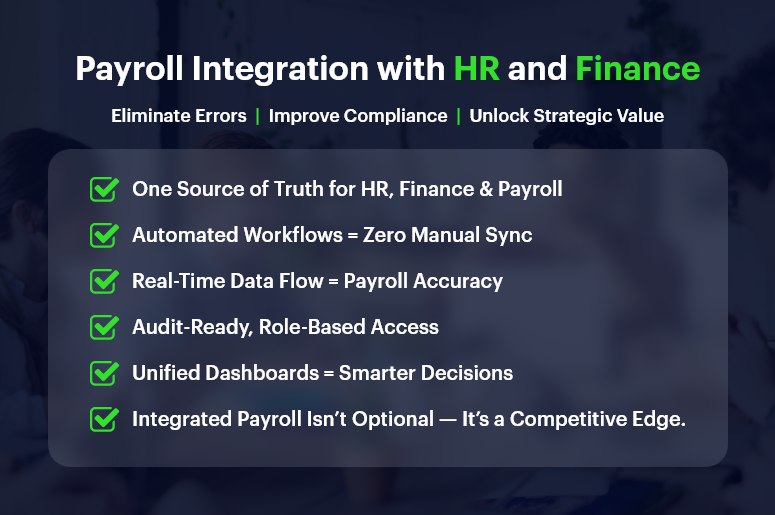
Business Need & Importance: Why Integration Matters Across Teams
Accurate payroll isn’t just about paying employees on time - it’s about consistency, compliance, and confidence across departments. When payroll doesn’t integrate with HR or finance, three gaps consistently open up:
1. Misaligned data creates errors
Even small discrepancies in hours, deductions, or classification can produce incorrect salaries or financial reports. In industries like retail, hospitality, or consulting - where overtime and varied pay structures are the norm - data alignment isn’t optional.
2. HR and finance operate in silos
Without integration, HR sees payroll data separately from finance’s budget view. That fragmentation delays reporting and quietly undermines workforce planning, since neither team is working from the same numbers.
3. Compliance becomes a moving target
PF, ESI, TDS rules, and now the phased rollout of India’s Labour Codes change often. Without automatic updates flowing into payroll, manual systems amplify compliance risk and audit exposure with every change.
This plays out differently by industry: manufacturing and logistics firms need aligned payroll, scheduling, and budgeting for accurate workforce cost planning; professional services firms need time tracking linked to payroll and client billing; fast-growing tech businesses need HR, payroll, and financial reporting connected in real time to support hiring at pace.
Best Practices & Actionable Tips: Boost Accuracy with Payroll Integration
Integrated systems aren’t magic - they run on a few consistent practices.
1. Use one platform for HR, attendance, and payroll
Rather than syncing separate tools, run HR, attendance, and payroll from a single shared data source. Changes in hours, benefits, or role assignment then flow into payroll calculations without a manual handoff in between.
2. Automate data flow between modules
Timesheets, leave entries, and benefit changes should update payroll and finance records automatically. When an HR manager marks an employee full-time or approves a bonus, the payroll run should reflect it without anyone re-entering the change.
3. Use audit trails and role-based access
Accurate reporting requires transparent records of what changed, when, and by whom. Role-based permissions let HR see hours and benefits while finance sees cost breakdowns - without either side over-exposing sensitive data, a requirement that’s sharpened under India’s DPDP Act, 2023.
4. Design approval workflows with teeth
Set up multi-tier approval - a team lead sign-off on timesheets before payroll processing, for example. Triggering payroll only after verification removes the last-minute corrections that come from processing on unverified data.
5. Keep compliance rules and tax logic in sync
Automated compliance tools should enforce current PF, ESI, TDS, and state-specific rules automatically, so no one is recalibrating deduction logic by hand every pay cycle - especially as Labour Code notifications roll out state by state.
6. Build unified reporting dashboards
Combine HR metrics (headcount, leave trends), payroll costs, and finance data (cost centers, GL entries) into one view. This is what actually enables better forecasting and budgeting, rather than three separate reports that don’t reconcile.
7. Give teams self-service access
Employees and managers should be able to check payslips, leave balances, and benefit information without opening an HR ticket. It cuts repetitive queries and keeps data visibility consistent across departments.
Customer Success/Case Study
GreenLeaf Consulting, a professional services firm, used IndPayroll to unify employee records, project billing, and payroll calculations - automating timesheet approvals, salary adjustments, tax rule updates, and benefit deductions. The results: payroll errors dropped 75% with manual adjustments nearly eliminated, processing time fell 50%, and finance forecasting accuracy improved 20%. By aligning HR, payroll, and finance in real time, GreenLeaf turned payroll into a data-driven advantage instead of a compliance risk.
Key Takeaways & Closing
Payroll integration with HR and finance is no longer optional - it’s a core requirement for accuracy, compliance, and efficiency in 2026.
- Manual or disconnected systems introduce errors, siloed data, and reporting delays.
- Integration unifies data, automates workflows, and reduces compliance risk at the same time.
- Accurate payroll becomes a source of strategic insight instead of a monthly scramble.
With INDPayroll unifying payroll, HR, and finance data, businesses gain real-time visibility that leads to better decisions, stronger employee trust, and lower operating costs.
Frequently asked questions
Run your next payroll in 15 minutes
Trusted by 1,000+ Indian businesses to run compliant payroll, automatically.
Keep reading
31 July 2025 · 4 min
Payroll Management31 July 2025 · 5 min
Payroll Management30 July 2025 · 5 min