Diwali Bonus Calculation in India 2026: How PF, ESI, TDS and Take-Home Pay Change
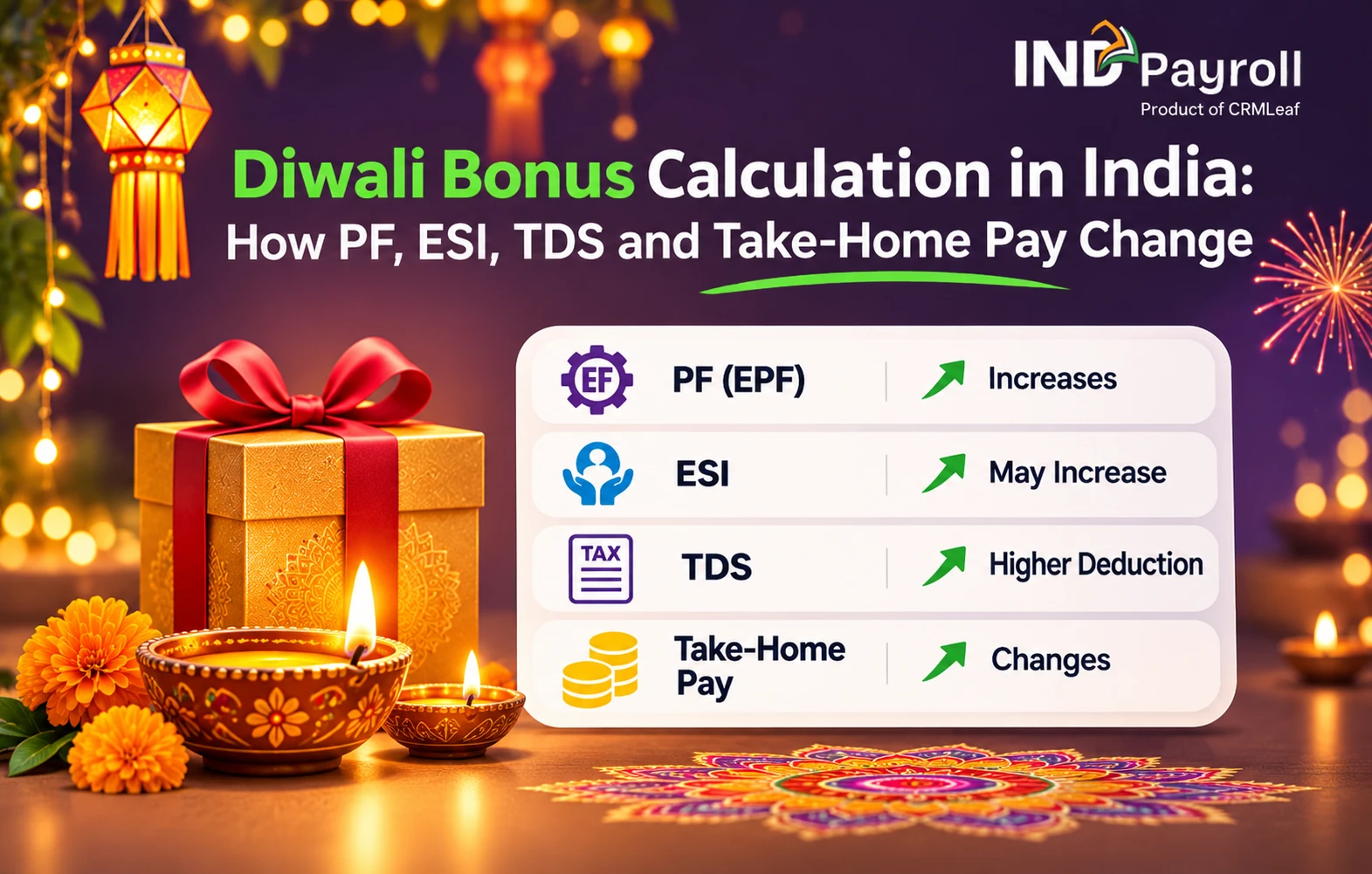
TL;DR: Diwali bonus calculation in India 2026 starts with the type of bonus, because statutory bonus, performance bonus, ex-gratia and gifts follow different rules. Statutory bonus for FY 2025-26 must reach eligible employees by 30 November 2026. PF, ESI and TDS each use their own wage base, so never apply them to total gross by default. INDPayroll keeps each earning in its own head so every deduction follows the right rule.
- Know the type first. Statutory bonus, performance bonus, ex-gratia payment and employer gift are taxed and processed differently.
- Statutory bonus has a formula. Eligibility is capped at ₹21,000 of Basic plus DA. The calculation uses ₹7,000 a month or the minimum wage, whichever is higher.
- The deadline is close. For a March year-end, statutory bonus is due within eight months, which is 30 November 2026.
- PF and ESI look at "wages", not gross. A bonus is excluded from wages, but it still counts when the 50% rule is tested.
- Cash bonus is always taxable. Employer gifts in kind stay tax-free only while the year's total remains under ₹15,000.
- Take-home is gross minus each deduction on its own basis. Never apply PF, ESI or TDS to total gross by default.
An employer announces a ₹10,000 festive bonus, and the payslip shows less. That gap is the most common bonus complaint HR teams hear after Diwali. This guide explains Diwali bonus calculation in India. It shows how the bonus is worked out, how it changes gross pay, and what happens to PF, ESI, professional tax and TDS.
Timing matters this year. Diwali fell on 8 November 2026, and statutory bonus for FY 2025-26 must reach employees by 30 November 2026. The rules have also changed. The Code on Wages replaced the Payment of Bonus Act. The PF wage ceiling rose to ₹25,000. The Income-tax Act, 2025 now governs salary TDS.
It is written for HR managers, payroll executives, finance teams and business owners who need numbers they can check.
What Types of Diwali Bonus Do Indian Employers Pay?
The problem. Four different payments often appear as "bonus" on a payslip, and each follows different rules. Classify the payment before you calculate anything.
| Type | Legally required? | Governed by | Payroll treatment |
|---|---|---|---|
| Statutory bonus | Yes, for eligible employees | Code on Wages, 2019 (Chapter IV) | Formula-based. Taxable salary. Excluded from PF and ESI wages, but counted in the 50% test |
| Performance or annual bonus | Only if the contract or policy says so | Employment terms or company policy | Taxable salary. PF and ESI treatment depends on the nature of the payment |
| Ex-gratia Diwali payment | No | Employer discretion | Taxable salary when paid in cash |
| Gift or voucher in kind | No | Employer discretion | Nil perquisite only within the ₹15,000 yearly limit |
The label does not decide the treatment. Calling a payment "ex-gratia" does not change how it is taxed. It should not be used to settle a statutory bonus that is already due.
The fix. Set up each category as its own earning head, such as Statutory Bonus, Performance Bonus and Ex-gratia. Each head can then carry its own PF, ESI and TDS settings.
How Is Statutory Diwali Bonus Calculated Under the Code on Wages?
The problem. Many guides still explain the Payment of Bonus Act, 1965, which stands repealed. Statutory bonus now sits in Chapter IV of the Code on Wages, 2019, in force since 21 November 2025. Employees also assume the bonus runs on their full salary. It does not.
The main rules are:
- Coverage: establishments with 20 or more employees.
- Service: at least 30 days worked in the accounting year.
- Eligibility ceiling: Basic plus DA up to ₹21,000 a month. The Labour Ministry fixed this in notification S.O. 4711(E) of 25 August 2026, effective from 21 November 2025.
- Calculation ceiling: ₹7,000 a month, or the applicable minimum wage if that is higher (S.O. 4710(E)).
- Rate: a minimum of 8.33% (or ₹100, whichever is higher) and a maximum of 20%, depending on allocable surplus. The minimum is payable even without surplus.
In short: Bonus = lower of actual monthly wage or the calculation ceiling × 12 × bonus percentage.
Worked example of statutory bonus
Take an employee with Basic plus DA of ₹20,000 a month. That is below ₹21,000, so the employee is eligible. Assume the state minimum wage is below ₹7,000, so the calculation wage is ₹7,000.
- Annual calculation base: ₹7,000 × 12 = ₹84,000
- Minimum bonus at 8.33%: ₹6,997
- Maximum bonus at 20%: ₹16,800
A declared Diwali bonus of ₹10,000 sits inside that range, at about 11.9% of the base.
The deadline. Section 39 requires payment within eight months of the close of the accounting year. Payment must be by credit to the employee's bank account. For a year ending 31 March 2026, that date is 30 November 2026.
The fix. Test eligibility on Basic plus DA. Store both ceilings in your payroll configuration. Confirm the minimum wage for your state and employment, and diarise 30 November. You can check a figure with the free bonus calculator.
Does Diwali Bonus Attract PF Deduction?
Short answer: generally no. A bonus is not part of PF wages, but it can still affect PF through the 50% rule.
The problem. Old guides say bonus is excluded from basic wages under the EPF Act. That framework has moved to the Code on Social Security, 2020, and the test is now more detailed. Our guide to the four Labour Codes and payroll covers the wider changes.
PF wages are Basic, DA and retaining allowance, plus any amount added back under Section 2(88). Bonus is one of the excluded payments. But if all excluded payments together exceed 50% of total remuneration, the excess is added back to wages. Commentary on the Labour Ministry's FAQs indicates that statutory bonus can count towards total remuneration for this test.
The ceiling has changed. From 17 September 2026, the PF wage ceiling is ₹25,000 a month under notification S.O. 5109(E), up from ₹15,000. At 12%, the employee share is capped at ₹3,000 a month on the ceiling. EY's alert, listed in the sources below, summarises the notification. Many online calculators still use ₹15,000, so check yours.
How the 50% rule can change PF in a bonus month
An employee earns Basic ₹20,000, HRA ₹6,000 and Special Allowance ₹4,000.
- With a ₹10,000 bonus: total pay is ₹40,000, and excluded payments are ₹20,000. That is exactly 50%, so nothing is added back. PF wages stay at ₹20,000 and PF is ₹2,400.
- With a ₹14,000 bonus: total pay is ₹44,000, so the 50% limit is ₹22,000. Excluded payments are ₹24,000, so ₹2,000 is added back. PF wages become ₹22,000 and PF is ₹2,640.
This follows the reading that bonus counts in total remuneration. Confirm the treatment with your compliance advisor before you change payroll settings.
Note: The PF ceiling change is for EPF only. The ESIC wage ceiling stays at ₹21,000 a month for general employees and ₹25,000 a month for employees with disabilities.
The fix. Keep PF settings separate for each earning head. Review the 50% test in every bonus month, and update the ₹25,000 ceiling in your payroll configuration. Our PF calculator can test an employee's figures.
Does Diwali Bonus Attract ESI Deduction?
Short answer: annual statutory bonus is generally excluded from ESI wages. Some incentive payments may not be.
The problem. Teams often apply ESI to total gross because the bonus lands in the same payslip. ESI follows its own wage definition. ESIC guidance issued in December 2025 applied the Code's wage definition, including the 50% rule, to ESI contributions.
Three points matter in a bonus month:
- Coverage ceiling: ₹21,000 of wages a month, and ₹25,000 for persons with disabilities. The guidance we reviewed shows no revision, but confirm on the ESIC portal.
- Rates: 0.75% from the employee and 3.25% from the employer.
- Other incentives: attendance or production incentives, and some performance payments, may be included in ESI wages depending on their nature and terms.
Once an employee is covered, crossing ₹21,000 during a contribution period does not generally end coverage at once. Contributions usually continue to the end of that period.
Example. An employee with wages of ₹20,000 pays ESI of ₹150 (0.75%), and the employer pays ₹650 (3.25%). If the only excluded payment is a ₹10,000 annual bonus, the 50% test is not triggered. The contribution is the same in the bonus month. Our ESIC rules guide for 2026 covers eligibility in more detail.
The fix. Test coverage on ESI wages and not on gross pay. Tag incentive payments separately from annual bonus so each one gets the right setting.
How Does Diwali Bonus Affect Professional Tax?
Short answer: it depends on the state. A bonus does not automatically raise professional tax.
Professional tax is a state levy. Each state sets its own slabs, salary definition and deduction frequency. Some states, including Maharashtra, Karnataka and West Bengal, levy it. Others do not. Our guide to professional tax slab rates by state lists the current position.
Odisha has changed. The state repealed its professional tax through an ordinance notified on 21 April 2026, effective from 1 April 2026. Employers should not deduct PT from Odisha salaries for any month from April 2026. Dues for earlier periods remain recoverable, as SCC Online reports in the sources below.
The fix. Apply professional tax by each employee's work location. Review your slabs whenever a state issues a notification. Multi-state employers should never use one company-wide PT table.
Is Diwali Bonus Taxable, and How Does TDS Change?
Short answer: yes. A cash bonus is taxable salary under the Income-tax Act, 2025. Employers deduct TDS on it under Section 392, which applies from 1 April 2026.
The problem. Employees see a smaller credit than the announced bonus because the projected annual tax goes up. Our explainer on TDS on salary covers the basics.
Payroll teams follow four steps:
- Estimate the employee's salary for the tax year.
- Add the bonus to that estimate.
- Recalculate annual tax under the employee's regime. The new regime under Section 202 is the default.
- Deduct the balance over the remaining months, or deduct more in the bonus month.
The phasing is a payroll policy choice. What matters is that the tax deducted across the year matches the estimated liability.
TDS example: ₹14 lakh salary with a ₹1 lakh bonus
This example uses the new regime for tax year 2026-27, with no other income or deductions.
| Step | Before bonus | After ₹1,00,000 bonus |
|---|---|---|
| Annual salary | ₹14,00,000 | ₹15,00,000 |
| Standard deduction | ₹75,000 | ₹75,000 |
| Taxable income | ₹13,25,000 | ₹14,25,000 |
| Tax on slabs | ₹78,750 | ₹93,750 |
| Cess at 4% | ₹3,150 | ₹3,750 |
| Total tax | ₹81,900 | ₹97,500 |
The bonus adds ₹15,600 of tax. That is 15.6%, made up of the 15% slab and cess, so the employee keeps about ₹84,400 of the ₹1,00,000. Employees close to the ₹12 lakh rebate limit need a separate check, because a bonus can push taxable income past it.
Gifts are different. Under Rule 15 of the Income-tax Rules, 2026, gifts and vouchers in kind are valued at nil. This holds while the year's total stays under ₹15,000, up from ₹5,000. Cash, bank transfers and gift cheques never qualify. Check the rule on the Income Tax Department portal.
The fix. Project TDS before payout, and tell employees what to expect. Test cases with our TDS calculator.
Try it free
Test your bonus run before you pay
Free plan for up to 10 employees. Upgrade for ESI, TDS and Form 16 when you are ready.
Start Free Trial Try the interactive demo
No credit card required.
How to Calculate Take-Home Pay After a Diwali Bonus
Net take-home pay equals total gross earnings minus PF, ESI, professional tax, TDS and any other authorised recoveries. Each deduction uses its own base. Our guide to salary components in India explains how those bases are built.
Here is the full example. It assumes the employee works in Odisha, the establishment is covered by ESI, and the employee uses the new tax regime.
| Component | Amount (₹) |
|---|---|
| Basic | 20,000 |
| HRA | 6,000 |
| Special Allowance | 4,000 |
| Regular gross | 30,000 |
| Diwali bonus | 10,000 |
| Total gross | 40,000 |
| Employee PF (12% of ₹20,000) | 2,400 |
| Employee ESI (0.75% of ₹20,000) | 150 |
| Professional tax (Odisha, repealed) | 0 |
| TDS (taxable income below ₹4 lakh) | 0 |
| Total deductions | 2,550 |
| Net take-home | 37,450 |
The annual salary is ₹3,60,000 plus the ₹10,000 bonus, which gives ₹3,70,000. After the ₹75,000 standard deduction, taxable income is ₹2,95,000, so no tax is due. The statutory minimum bonus for this employee is ₹6,997, so a ₹10,000 payout meets the legal floor.
If the employee works in a state that levies professional tax, deduct it as per that state's slab. Employer contributions, such as ₹650 of ESI, are a company cost and do not reduce take-home pay.
What If the Diwali Bonus Is Paid Before Month-End Payroll?
The problem. Many employers transfer the bonus before Diwali, outside the monthly run. If payroll does not know about it, the employee can be paid twice. TDS can also be projected on the wrong income.
Why it happens. The payment is made from the bank account while the payroll record stays unchanged. The result is a duplicate payout, a wrong TDS projection and a Form 16 that does not match the bank statement.
Follow these steps for an early payment:
- Record the bonus as an earning against the employee, with the date and bank reference.
- Classify it as statutory, performance or ex-gratia.
- Deduct TDS when the bonus is paid, and update the annual tax projection.
- Apply the PF, ESI and professional tax settings for that earning head.
- Show it on the month-end payslip as an earning, with an offsetting "already paid" line so net pay is not doubled.
- Match payroll totals to the bank statement before you approve the run.
Prevention. Route every bonus payment through payroll, with one approver and one record.
Common Diwali Bonus Payroll Mistakes and How to Fix Them
Most bonus errors come from old configuration, not from bad arithmetic. These are the ones we see most often.
| Mistake | Why it happens | The fix |
|---|---|---|
| Using Payment of Bonus Act rules | Templates were not updated after 21 November 2025 | Refer to the Code on Wages and the notified ceilings |
| Calculating bonus on full salary | The eligibility ceiling and calculation ceiling get mixed up | Test eligibility on Basic plus DA, and calculate on ₹7,000 or minimum wage |
| Applying PF or ESI to total gross | The bonus appears on the same payslip | Compute each deduction on its own wage base |
| Skipping the 50% test in bonus months | The test is checked only at set-up | Re-run it whenever a bonus is paid |
| Keeping the PF ceiling at ₹15,000 | The configuration predates 17 September 2026 | Update to ₹25,000 |
| Leaving TDS unchanged | Monthly TDS is fixed at the start of the year | Reproject annual tax each time a bonus is paid |
| Paying outside payroll | The bonus goes out as a bank transfer | Record it in payroll and reconcile |
| Deducting PT in Odisha | The state setting was never removed | Stop deductions from April 2026 |
Diwali Bonus Payroll Checklist
Use this list before you approve a bonus month. It works alongside our payroll compliance checklist.
- Classify each payment as statutory bonus, performance bonus, ex-gratia or gift.
- Confirm eligibility on Basic plus DA (up to ₹21,000) and 30 days of service.
- Use ₹7,000, or the minimum wage if higher, as the calculation wage.
- Pay statutory bonus by bank credit on or before 30 November 2026.
- Apply the ₹25,000 PF ceiling and run the 50% test.
- Check ESI wages against the ₹21,000 ceiling.
- Apply professional tax by state, and none in Odisha from April 2026.
- Reproject annual TDS and tell employees what to expect.
- Keep gifts in kind well under ₹15,000 for the year.
- Record any off-cycle payment and reconcile it with the bank statement.
- Show the bonus as a separate earning on every payslip.
How INDPayroll Helps With Bonus Month Payroll
Bonus month combines several calculations in one run, and a spreadsheet makes each one a manual step. INDPayroll's payroll software helps with the pieces this guide describes:
- Salary structures: Basic, HRA, LTA and special allowance, so each earning sits in its own head.
- PF and ESI: the PF and ESI compliance module applies the PF wage ceiling and prepares an ECR file for the portal. ESI thresholds are tracked for each employee.
- TDS: annual tax is projected for each employee, so a bonus month does not catch anyone off guard.
- Professional tax: state slabs are kept by work location.
- Payslips: the bonus shows as its own earning line.
Before the bonus run, check that your ceilings and wage settings match the rules above.
The free plan covers up to 10 employees with basic PF. ESI, TDS and Form 16 are part of the Essentials plan at ₹52 per employee per month, billed annually. The Ultimate plan, which includes the employee self-service portal, is ₹75 per employee per month, billed annually. Prices exclude GST. See the pricing page for current plans.
To test numbers first, try the free bonus calculator or the payslip generator.
Frequently Asked Questions
Is Diwali bonus taxable in India?
Yes. A cash Diwali bonus is salary income, taxed at the employee's slab rate through TDS under Section 392 of the Income-tax Act, 2025. It is added to estimated annual income, so TDS usually rises. Employer gifts in kind are different and stay tax-free while the year's total is under ₹15,000.
How is statutory bonus calculated in 2026?
Take the lower of the actual monthly wage or the calculation ceiling, which is ₹7,000 or the minimum wage if higher. Multiply by 12, then by the bonus rate of 8.33% to 20%. The employee needs Basic plus DA up to ₹21,000 and at least 30 days of service.
Is PF deducted from Diwali bonus?
Generally no, because bonus is excluded from PF wages. Excluded payments above 50% of total remuneration are added back to wages, though. Commentary on the Labour Ministry's FAQs suggests statutory bonus counts in that test. The PF wage ceiling is ₹25,000 from 17 September 2026.
Is ESI deducted from Diwali bonus?
Annual statutory bonus is generally excluded from ESI wages, so no ESI is deducted on it. Attendance or production incentives may be included, depending on their terms. The ESI wage ceiling is ₹21,000 a month, with 0.75% paid by the employee and 3.25% by the employer.
Is Diwali bonus mandatory for every employee?
No. Statutory bonus is mandatory for eligible employees in establishments with 20 or more employees. Festive ex-gratia payments and gifts are discretionary, unless the employment contract or company policy promises them.
What is the last date to pay statutory bonus for FY 2025-26?
Section 39 of the Code on Wages requires payment within eight months of the close of the accounting year. For a year that ended on 31 March 2026, the last date is 30 November 2026. Pay by bank credit and keep a record of each payment.
Is a Diwali gift from an employer tax-free?
Gifts and vouchers in kind are valued at nil under Rule 15 of the Income-tax Rules, 2026, while the year's total stays under ₹15,000. Cash and gift cheques are always taxable as salary. The limit covers all employer gifts in the year, not only Diwali.
How much TDS is deducted on a Diwali bonus?
There is no fixed rate. The employer recalculates annual tax on salary plus bonus, so the effect equals the employee's marginal slab rate plus 4% cess. In the example above, a ₹1,00,000 bonus added ₹15,600 of tax, which is 15.6%.
Conclusion
Diwali bonus calculation in India comes down to three steps. First, classify the payment. Second, calculate each statutory deduction on its own wage base. Third, reproject annual TDS and reconcile every payment before you approve payroll.
The rules moved in 2025 and 2026, so last year's template may no longer fit. Check the Code on Wages ceilings, the ₹25,000 PF ceiling, the 50% wage test and your state's professional tax position. Then diarise 30 November for statutory bonus.
Ready when you are
Run your next bonus month with fewer manual steps
Start on the free plan for up to 10 employees. Talk to our team if you run payroll for more people or for several clients.
Start Free Trial Try the interactive demo Talk To Sales
No credit card required.
Sources and references
Figures and rules were checked on 13 November 2026. Confirm each against the official source before you act.
- Ministry of Labour and Employment: Code on Wages and Code on Social Security, notifications and FAQs
- Employees' State Insurance Corporation: ESI coverage and contribution guidance
- Income Tax Department: Income-tax Act, 2025 and Income-tax Rules, 2026
- EY alert on the ₹25,000 PF wage ceiling (notification S.O. 5109(E), 17 September 2026)
- BDO alert on the PF wage ceiling
- SCC Online on the Odisha professional tax repeal
Run your next payroll in 15 minutes
Trusted by 1,000+ Indian businesses to run compliant payroll, automatically.