
Salary Advance Recovery Rules: Stay Within the 50% Cap
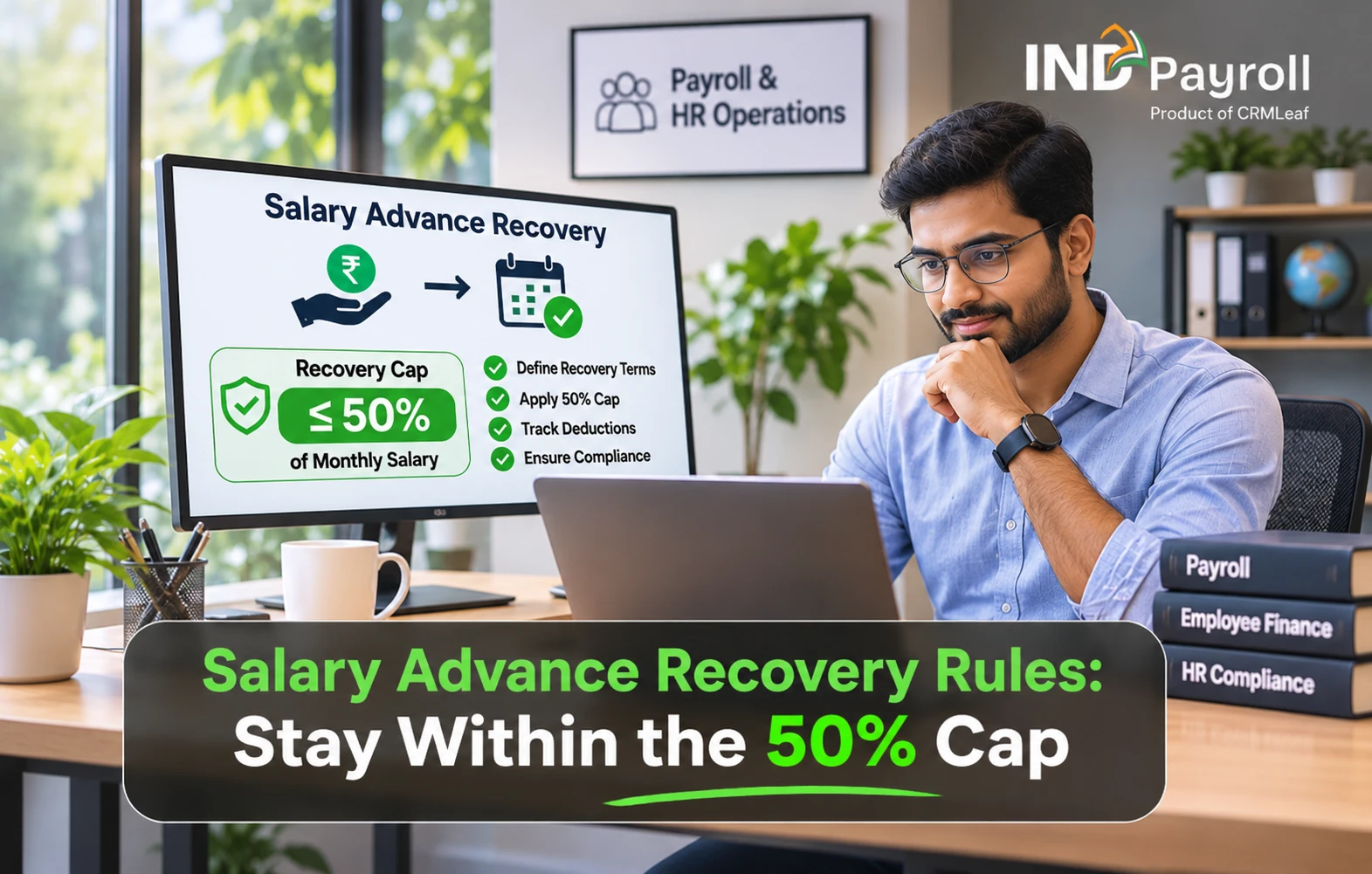
TL;DR: Under the Code on Wages, all listed deductions together, including advance and loan recovery, cannot exceed 50% of wages in a wage period. PF and TDS count towards that 50%, so they use up room before any advance instalment. Any excess carries forward to later months, and final wages are due within two working days of exit. INDPayroll handles loan and advance deductions, but you still check the monthly total yourself.
- Section 18 allows only the deductions the Code lists. Advances and loans are on the list.
- All listed deductions together cannot exceed 50% of wages in a wage period.
- Any excess is carried forward and recovered later, within the same 50% limit each month.
- Advance recoveries are set by the employer in instalments and recorded in the Form IV register.
- Final wages are due within two working days of exit, and the Code does not make them depend on exit clearance.
- A leftover loan or advance balance cannot be assumed recoverable from final wages. Handle it separately and in writing.
An employee takes a ₹60,000 advance, and payroll deducts a large instalment every month. Or an employee resigns with a loan outstanding, and HR nets the whole balance from the final settlement. Both look practical. Under the Code on Wages, both can also be wrong.
The salary advance recovery rules changed when the Code came into force on 21 November 2025. Total deductions in a wage period now have a flat 50% limit, and final wages are due within two working days. This guide explains what you can recover, how much, and when, so your payroll stays inside the law.
What do the salary advance recovery rules say?
The Code on Wages permits only authorised deductions, and a salary advance is one of them. Section 18 says no deduction may be made from wages except as the Code allows. It then lists the permitted purposes. Recovery of advances of whatever nature, with interest due, is one of them.
Section 18(3) sets the limit. The total of all listed deductions in a wage period cannot exceed 50% of the employee's wages. Under the older Payment of Wages Act, deductions could reach 75% in some cases, so the cap is tighter than many teams remember.
Section 18(4) says the excess may be recovered in the prescribed manner. Rule 13 of the Code on Wages (Central) Rules, 2026 sets out that manner. The excess is carried forward to later wage periods and recovered in instalments, so that no month's recovery crosses 50% of that month's wages.
Rule 19 deals with advances. The employer sets the instalments, they must stay within the 50% limit, and the details go into the register in Form IV.
Which deductions count towards the 50% cap?
On a plain reading, every deduction listed in Section 18(2) counts. The cap applies to "the total amount of deductions" under that sub-section. That list includes more than advances.
| Deduction under Section 18(2) | Counts towards the 50%? |
|---|---|
| Fines | Yes |
| Absence from duty | Yes |
| Damage to or loss of goods entrusted for custody | Yes |
| Housing and amenities supplied by the employer | Yes |
| Advances, with interest, and wage overpayment adjustment | Yes |
| Loans for house-building or other approved purposes | Yes |
| Income tax and other statutory levies | Yes |
| PF, pension and health insurance contributions | Yes |
| Cooperative society, trade union fees (written authorisation) | Yes |
Two points deserve care. First, PF and TDS sit in the same list, so they use up part of the 50% before any advance instalment is considered. Second, the Code says 50% of "such wages", and "wages" is a defined term in Section 2(y). It means basic pay, dearness allowance and retaining allowance, plus any excluded allowances that exceed half of total remuneration. It is not gross pay or take-home pay. Confirm the base with your CA or labour-law adviser, and apply it the same way each month.
Worked example: how much room is left for an advance instalment?
Here is a made-up case. An employee has wages of ₹30,000 for the month, and the company advanced ₹60,000. The figures are illustrative.
| Item | Amount |
|---|---|
| Wages for the wage period | ₹30,000 |
| 50% cap | ₹15,000 |
| PF employee share (12% of ₹25,000 ceiling) | ₹3,000 |
| TDS (illustrative) | ₹1,200 |
| Professional tax (illustrative) | ₹200 |
| Total other deductions (PF + TDS + PT) | ₹4,400 |
| Room left for the advance instalment | ₹10,600 |
Now compare two schedules.
- Schedule A: ₹10,000 a month for six months. Total deductions are ₹14,400 each month, which is inside the ₹15,000 cap. The advance clears in month six.
- Schedule B: ₹15,000 a month for four months. Total deductions would be ₹19,400. That is ₹4,400 above the cap. Under Rule 13, the ₹4,400 excess is carried forward and recovered in later months, still within the cap.
Schedule B is the trap. It looks faster, but it breaks the monthly limit and creates a carry-forward balance that you must track. So size the instalment to the room, not to the repayment target.
Try it free
See every deduction on one payslip
Run a test payroll free for up to 10 employees and check your monthly deduction total. Full PF, ESI and TDS compliance comes with the Essentials plan.
Start Free Trial Try the interactive demo
No credit card required.
Advance or loan: what is the difference in recovery rules?
The Code treats them separately. An advance is recovered under Section 23 and Rule 19. A loan sits under Section 24 and Rule 20.
- Advance given before joining. Recover it from the first payment of wages for a complete wage period. Advances for travelling expenses are not recovered this way.
- Advance given after joining, or wages paid in advance. Recover it in employer-set instalments within the 50% cap, and record it in Form IV.
- Loans. Rule 20 points to the Central Government's instructions on how much may be lent and at what interest. The Rules do not print a loan limit or a rate, so do not quote one.
Interest-free or low-interest loans can also have tax effects for the employee. Confirm that treatment with your CA before you finalise a loan policy.
What can you recover at exit, and when?
Final wages are due within two working days. Section 17(2) of the Code applies when an employee resigns, is removed, dismissed or retrenched. The sensible reading is that the two days run from the last working day. The Code does not make payment of wages conditional on exit clearance or a no-dues declaration, as LiveLaw's analysis points out.
The two-day clock covers wages as the Code defines them, not every item in a settlement. Gratuity, for instance, follows its own timeline. The table below shows how common recoveries fit.
| Item at exit | Position under the Code | What to do |
|---|---|---|
| Salary up to the last working day | Wages, due within two working days | Pay on time |
| Advance or loan balance | Recoverable by deduction only within the 50% cap for that wage period. The Rules carry excess to "succeeding" periods, and none exists after exit. | Deduct within the cap. Pursue the balance separately, in writing, with advice. |
| Notice-pay shortfall | No clause in Section 18(2) names it. A payment by the employee to the employer is itself treated as a deduction. | Do not net it from wages without advice. Use other lawful routes. |
| Asset damage or loss | Allowed only for goods expressly entrusted for custody, where loss is directly attributable to neglect or default, and after the prescribed procedure | Follow the procedure rule before deducting |
| Gratuity | Separate timeline | Do not hold wages back for it |
Some commentators argue that deducting disputed amounts from final wages is hard to square with Section 18. Others still treat it as routine. The text does not settle what happens to an advance balance that exceeds the cap on the last wage period. Until a state authority or court clarifies, pay the undisputed wages in two working days and keep disputed recoveries out of that payment.
Step-by-step: set up a compliant recovery
- Classify the amount. Decide whether it is an advance, a loan or an overpayment adjustment, because each has its own rule.
- Put it in writing. Rule 19 does not require the employee's agreement to the schedule. A signed note with the amount, instalments and any interest still prevents disputes.
- Calculate the room. Take 50% of wages and subtract the other authorised deductions for the month, including PF and TDS.
- Fix the instalment. Keep it at or below the room. Re-check it whenever pay, PF wages or TDS change.
- Record it in Form IV. Log every recovery, as Rule 19 requires.
- Track any carry-forward. If a month goes over, carry the excess and recover it later within the cap.
- Show it on the payslip. List the advance or loan instalment as its own line.
- Review before every exit. Check the last month's room and the outstanding balance before the settlement is processed.
Common mistakes to avoid
- Recovering the full balance from one salary because the employee is leaving
- Counting only the advance and forgetting that PF and TDS use up part of the cap
- Holding final wages until exit clearance is complete
- Keeping no register of instalments and carry-forward balances
- Treating a fine and an advance as one deduction, when each has its own rules
- Assuming the Central Rules apply everywhere, when many private establishments follow state rules
Central rules or state rules: which apply to you?
The Central Rules apply where the Central Government is the appropriate Government. Elsewhere, the state's own Code on Wages rules apply. Rajasthan and Bihar, for instance, have notified rules with the same carry-forward approach under their own rule numbers. Under Section 2 of the Code, the State Government is the appropriate Government for any establishment not assigned to the Central Government. That covers most private employers. Check which applies to you, then read that rule set.
Checklist: salary advance recovery readiness
- Advance and loan policy updated for the 50% cap
- Signed agreement for every advance or loan
- Monthly room calculated after PF, TDS and other deductions
- Instalments set within the room
- Form IV register maintained
- Carry-forward balances tracked
- Exit checklist includes the outstanding balance and last-month room
- Final wages paid within two working days
- Disputed recoveries handled separately and in writing
- Applicable central or state rules confirmed
How does INDPayroll help with advance recovery?
INDPayroll's payroll engine lists loan recovery and advance settlement among the deductions it handles. Payslips show Loan EMIs as a separate line. Post-run corrections move into the next cycle as adjustments, with an audit trail of who changed what and when. You can read how that works in the adjustments and corrections guide.
The software does not decide your instalment for you. Check the payroll preview each month to confirm total deductions stay inside the cap. For exits, the free F&F settlement calculator helps you estimate pay, leave, gratuity and recoveries before you finalise a settlement.
To see how deductions fit into a wider payroll review, read our guide to payroll mistakes HR managers should avoid. See the pricing page for current plans.
Frequently asked questions
What is the maximum an employer can deduct from salary?
The total of all authorised deductions in a wage period cannot exceed 50% of the employee's wages under Section 18(3) of the Code on Wages. The excess is carried forward and recovered later.
Can an employer recover a salary advance from salary?
Yes. Section 18(2) allows recovery of advances, with interest due. The employer sets the instalments, keeps total deductions within 50%, and records each recovery in Form IV.
What happens to deductions above the 50% limit?
Under Rule 13 of the Central Rules, the excess is carried forward to later wage periods. It is recovered in instalments so that no month's total crosses 50% of that month's wages.
Do PF and TDS count towards the 50% cap?
On a plain reading, yes. PF contributions and income tax are listed in Section 18(2), and the cap applies to the total of that list. Confirm the wage base with your adviser.
Can an advance be recovered from final settlement?
Only within the 50% cap for the wage period concerned. The Rules carry excess to later periods, and none exists after exit. Handle any remaining balance separately, in writing, with advice.
Can final wages be held back until exit clearance?
No clause in the Code makes payment of wages depend on exit clearance. Wages are due within two working days of exit under Section 17(2).
Conclusion
The 50% cap turns advance recovery into a monthly calculation. Count every authorised deduction, size the instalment to the room that remains, record it, and pay final wages on time. Keep disputed recoveries separate from the wages you owe.
Ready when you are
Keep deductions, payslips and settlements in one workflow
Start on the free plan for up to 10 employees. Talk to our team if you run payroll for more people or for several clients.
Start Free Trial Try the interactive demo Talk To Sales
No credit card required.
Sources
Run your next payroll in 15 minutes
Trusted by 1,000+ Indian businesses to run compliant payroll, automatically.