
Building a Scalable Payroll System: What to Consider as You Grow?

TL;DR: Scalable Payroll System
A scalable payroll system keeps pay accurate and compliant as you add people, sites and pay types. Look for one system for payroll, HR and attendance, automatic compliance updates, multi-state support and cost tracking. INDPayroll offers a free plan for up to 10 employees and paid plans at ₹52 to ₹75 per employee per month, billed annually, so your cost follows your headcount.
Payroll is often the first system to strain when a business grows. A spreadsheet that worked for 10 people starts to fail at 40. Pay goes out late, a deduction is wrong, or a filing is missed. These problems hurt trust and morale as well as the budget.
This guide explains why scalability matters and gives eight clear strategies to build a payroll system that grows with you. It is written for founders, HR heads and finance teams in India.
Why Scalability Matters: The Business Case for a Future-Proof Payroll
Scalability matters because payroll risk grows faster than headcount. Each new employee, state or pay type adds rules to follow. Four pressures show up as you grow.
- Compliance exposure rises. More staff and more locations mean more PF, ESI, TDS and Professional Tax rules. India's phased Labour Codes and state-specific tax and minimum wage rules add to the load. A missed deadline can mean penalties. You can track the latest changes on our labour law updates page.
- Manual work stops scaling. Spreadsheets and disconnected tools lead to duplicate entries and missed payments. Automation removes much of this manual work.
- Setup must be quick. Fast hiring, new offices and seasonal staff need a system that can add people in minutes, not days.
- On-time pay protects retention. Growth is also when you most risk losing good people. Late or wrong pay is one of the quickest ways to lose their trust.
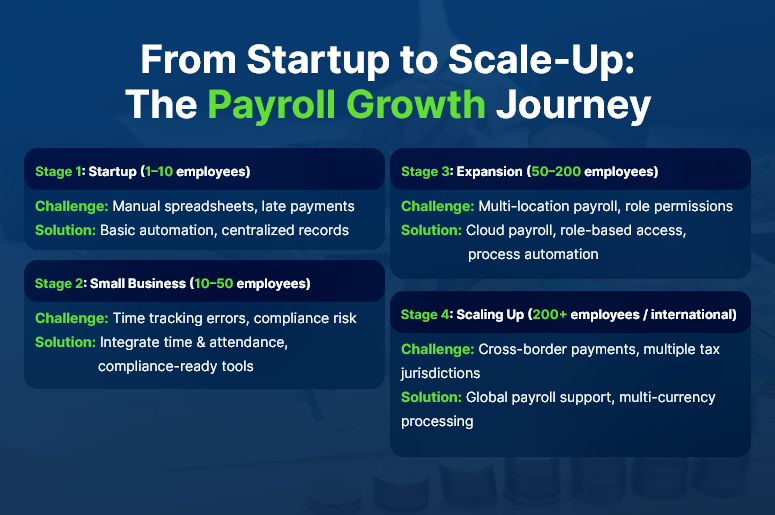
The right system also saves money. When payroll takes fewer hours, your team spends that time on work that grows the business. See our guide to the payroll challenges small businesses face for more on this.
Growing faster than your payroll process?
INDPayroll handles PF, ESI, TDS and Professional Tax on every run. Start free for up to 10 employees.
Free forever up to 10 employees · No credit card
How to Build a Scalable Payroll System: 8 Actionable Strategies
1. Keep payroll, HR and attendance data in one system. When these sit together, a new hire, a leave day or an overtime hour reaches payroll without re-typing. This single step removes many errors. Read how payroll integration with HR and finance boosts accuracy.
2. Use cloud-based payroll software. Cloud tools give your team real-time access from any place. They also update statutory rates for you, so you do not track each change by hand.
3. Automate wage calculations, statutory deductions and payslips. Let the system work out gross pay, PF, ESI, TDS and net pay. Then create payslips in bulk. Our payslip and reports generator shows how this works.
4. Set role-based permissions. Payroll data is sensitive. Give each person access only to what they need. HR, finance, managers and employees should each see a different view.
5. Handle multi-state rules automatically. Professional Tax, minimum wages and holidays differ by state. A good system applies the right rules to each location, so you do not set them up by hand each time you open an office.
6. Sync time tracking, attendance, overtime and leave. Hours drive pay for many teams. When attendance and leave feed payroll directly, you remove a major source of disputes.
7. Support every type of worker. Full-time, part-time, contract and gig workers each follow different rules. Your system should handle all of them. Our guide on how to simplify payroll for contract, gig and remote employees goes into detail.
8. Track payroll cost by department or project. Cost reports help you plan budgets and hiring. You can see which teams cost the most and how that changes over time.
Before you buy, check each strategy against your own plans for the next two or three years. Our end-to-end payroll processing checklist for growing businesses is a useful companion.
Customer Success Example
An illustrative example. Picture a fast-growing software company that opens offices in three states in one year. At first, payroll runs on spreadsheets. Each new office adds a new set of Professional Tax rules, new attendance files and more people to pay. The payroll team starts working late every month, and corrections pile up.
The company moves to an integrated payroll system. HR, attendance and payroll data now live together. State rules apply on their own, and finance can see cost by team without asking for a report. Processing takes much less time, and the team stops working late on salary day.
This is an example of the pattern many growing companies report, not a measured result. Your gains will depend on your starting point. Time your current payroll cycle and count the monthly corrections. Then compare after two or three runs on the new system.
Key Takeaways: Future-Proofing Your Payroll Operations
- Spreadsheets and old tools do not scale. They break as people, sites and rules multiply.
- Keeping payroll, HR and attendance in one system removes common bottlenecks.
- Automation, multi-state compliance and cost tracking are the core of a scalable system.
- Choose software whose pricing grows in a clear way with your team.
- Test any system with a real payroll run before you commit.
A scalable system lets you hire, open new offices and pay on time without adding payroll stress. INDPayroll is free for up to 10 employees. The Essentials plan (₹52 per employee per month, billed annually) supports up to 200 employees with complete PF, ESI, PT, LWF and TDS compliance. The Ultimate plan (₹75 per employee per month, billed annually) is for unlimited employees and adds attendance, shift management and Employee Self-Service. See the pricing page for the full plan details.
Frequently asked questions
Run your next payroll in 15 minutes
Trusted by 1,000+ Indian businesses to run compliant payroll, automatically.
Keep reading
30 July 2025 · 5 min
Payroll Management31 July 2025 · 4 min
Payroll Management29 July 2025 · 6 min