
End-to-End Payroll Processing Checklist for Growing Businesses
Payroll isn’t just about paying your people - it’s about staying compliant, earning trust, and keeping your team motivated. But as your business grows, running payroll manually becomes risky, slow, and error-prone. More than a third of small businesses face a payroll-related penalty at some point, and almost always it traces back to a step that got skipped, not a calculation that was wrong.
This guide walks through a practical, end-to-end payroll processing checklist for growing businesses in 2026 - where most companies slip up, what to fix, and how to make the whole cycle seamless.
The Business Case: Why End-to-End Payroll Processing Matters
Payroll goes far beyond cutting a paycheck. When it’s inaccurate or non-compliant, the ripple effects show up everywhere: employee dissatisfaction, audits, penalties, and real financial losses.
Here’s why a disciplined, end-to-end process matters across industries:
- Retail and hospitality. High turnover and hourly wages make real-time payroll updates critical - delays here translate directly into retention problems.
- Manufacturing and logistics. Overtime, shift differentials, and contract workers demand precision, or you’re carrying real compliance risk on every pay cycle.
- Professional services. Billable hours, bonuses, and project-based compensation need automation to prevent calculation errors from compounding across clients.
Whatever your industry, a streamlined payroll process improves productivity, builds employee trust, and reduces the operational burden on a small HR or finance team.
The Ultimate End-to-End Payroll Processing Checklist
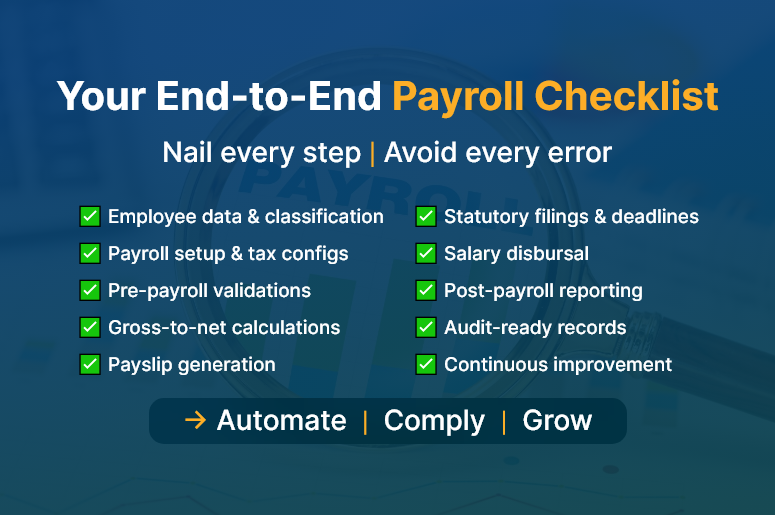
Here’s the complete checklist, broken into seven actionable stages. Each one closes a gap that commonly causes errors or penalties.
1. Employee Data Collection & Classification
- Capture full employee details: PAN, UAN, bank details, job role, and benefit preferences at onboarding.
- Classify employment type correctly: Distinguish full-time, part-time, contract, and gig workers - India’s Labour Codes now formally define gig and platform worker categories, and misclassification is one of the costliest mistakes an SME can make.
- Track working hours and shifts: Use digital timesheets or biometric systems to capture accurate work data from day one.
2. Payroll Setup & Configuration
- Set pay frequencies: Define weekly, bi-weekly, or monthly cycles based on your company structure.
- Automate statutory rates and deductions: Keep PF, ESI, Professional Tax, and TDS current with the latest central and state rules, so no one is calculating from a rate table that’s a year out of date.
- Integrate attendance systems: Sync leave, holidays, and worked hours from your attendance system directly into payroll.
3. Pre-Payroll Validation
- Verify attendance data: Double-check logged hours, approved leave, and overtime entries before they hit the pay run.
- Audit pay structure changes: Validate bonuses, commissions, and raises before final processing - not after payslips go out.
- Confirm deductions: Ensure benefit, insurance, and loan-repayment deductions are accurate and approved.
4. Payroll Calculation & Review
- Run gross-to-net calculations: Automatically compute gross salary, statutory deductions, and net pay.
- Cross-check with payroll software: Use automated payroll software to eliminate spreadsheet fatigue and reduce human error at the calculation stage.
- Generate payslips: Produce detailed, downloadable payslips so every employee can see exactly how their pay was calculated.
5. Compliance & Statutory Filings
- Generate statutory forms: Automatically prepare PF ECR filings, ESI returns, TDS Form 24Q, and Form 16 instead of compiling them by hand at deadline time.
- Meet submission deadlines: Set reminders for every filing and deposit deadline - most payroll penalties come from being late, not from wrong amounts.
- Stay audit-ready: Maintain digital records and a complete audit trail to satisfy labour law recordkeeping requirements.
6. Payment Processing
- Schedule timely payments: Use integrated banking or payroll software to process salaries without manual intervention.
- Disburse reimbursements on cycle: Include travel or expense claims in the current pay run to avoid payment lags and employee frustration.
- Reconcile bank statements: Match every payment against the payroll run and your accounting books before closing the cycle.
7. Post-Payroll Reporting & Feedback
- Share detailed reports: Provide department-wise breakdowns and payroll summaries to finance and HR.
- Track payroll KPIs: Monitor accuracy, error rate, cycle time, and compliance status over time - not just whether the pay run finished on schedule.
- Collect employee feedback: Use it to catch recurring confusion or disputes before they become a pattern.
Why a Unified System Changes This for Scaling Teams
Disconnected tools create fragmented processes - and fragmentation is where errors hide. A unified payroll platform brings everything from employee onboarding to statutory filing into one workflow:
- HR integration: New hire data flows automatically from onboarding into payroll setup - no re-entry, no version mismatch.
- Real-time tracking: Dashboards show payroll progress, pending validations, and payment status at a glance.
- Audit-ready reports: Generate compliance reports, payslips, and tax documents on demand instead of assembling them manually each quarter.
- Scalability: Whether you have 20 employees or 200, the same system and process scale with you, minus the added manual work.
Customer Success
Finovate Solutions, a 50-person IT services company, used IndPayroll to cut payroll errors by 95% and reduce processing time from three days to four hours - by integrating employee timesheets with payroll, enabling automatic compliance checks and statutory form generation, and streamlining payouts and payslip delivery. The shift saved time and measurably reduced compliance risk.
Key Takeaways & Closing
A smooth, end-to-end payroll process doesn’t just prevent errors - it builds trust, ensures compliance, and frees up time for strategic work.
- Map your payroll process and identify exactly where bottlenecks or manual handoffs occur.
- Automate wherever possible - manual work invites the mistakes that cost the most to fix later.
- Build compliance into the workflow, not into a once-a-quarter scramble, since statutory rules change frequently.
- Unify your systems - disconnected HR, attendance, and payroll tools are where most errors originate.
With the right process and the right tools, payroll becomes a growth enabler instead of a recurring back-office risk.
Frequently asked questions
Run your next payroll in 15 minutes
Trusted by 1,000+ Indian businesses to run compliant payroll, automatically.
Keep reading
31 July 2025 · 4 min
Payroll Management31 July 2025 · 4 min
Payroll Management30 July 2025 · 4 min